
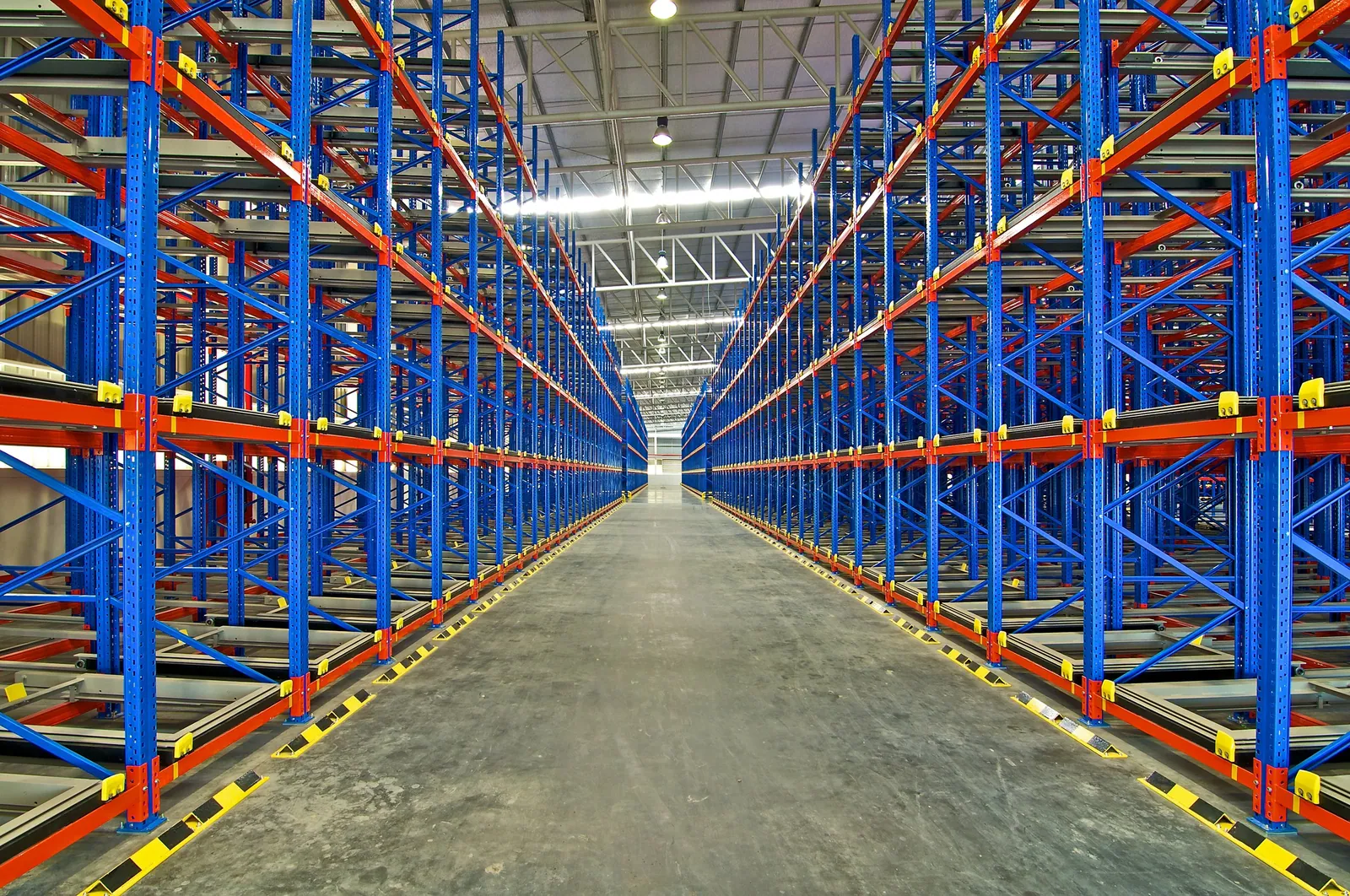
Why Dense Storage
When a few SKUs make up most pallets, storing them deep fits more pallets on the same floor than selective rack. Three systems do it with a standard forklift.
The Three in One Table
| Drive-in | Push-back | Pallet flow | |
|---|---|---|---|
| How it works | Truck drives into the lane on rails, stacks to the back | Nested carts on inclined rails; each new pallet pushes the stack back | Pallets roll on wheeled rails from the load end to the pick end |
| Rotation | LIFO (drive-through: FIFO) | LIFO | FIFO |
| Depth | 3 to 10+ pallets | 2 to 6 | 2 to 20+ |
| Density | Highest | High | High |
| Selectivity | One SKU per lane, all levels | One SKU per lane per level | One SKU per lane per level |
| Truck time | Slowest: drives in and backs out, slow in the lane | Fast: loads and unloads from the aisle | Fast: loads at one end, picks at the other |
| Damage | Highest: uprights inside the lane get hit | Low | Low |
| Honeycombing (empty slots you cannot use) | Worst | Moderate | Least |
| Cost per position | Lowest | Middle | Highest |
| Typical use | Cold storage, bulk, seasonal, few SKUs in volume | Mixed SKUs in volume, fast turns | Dated product, food, pharma, high-throughput |
Drive-In: Most Pallets for the Least Money
Lanes the truck drives into, one SKU per lane, usually 4 to 8 deep and 3 to 5 high. No moving parts makes it the cheapest dense system, and the densest in a freezer.
Trucks enter slowly, pallet raised, and back out. Clipped uprights carry the lane rails, so damage is structural. A half-full lane cannot take another SKU, so real use of the space is lower than the position count. Drive-in wins with few SKUs, big volumes, slow turns and a tight budget.
Push-Back: Density With Speed
Lanes hold 2 to 6 pallets on nested carts. The truck stays in the aisle, pushing the stack back to load and letting it roll forward to unload. Each level of each lane is a separate SKU, so it holds many more SKUs than drive-in, and the truck works from the aisle.
It is LIFO, so dated product fits poorly unless lanes are managed by lot, and carts cost more per position than drive-in. It is the one we install most.
Pallet Flow: FIFO at Volume
Rails tilt from the load aisle to the pick aisle; brakes control speed; first in is first out. One SKU per lane per level, 2 to 20 deep, with loading and picking on separate aisles.
The most expensive of the three, and it needs a good floor and sound pallets. It wins when rotation is a rule: food, beverage, pharma, dated goods, and staging a day's shipping. Carton flow does the same for cases.
How to Choose
- Must it rotate? Yes: pallet flow (or drive-through for very few SKUs). No: go on.
- How many SKUs in the block? Few, in volume: drive-in. Many: push-back.
- How fast? More than a few moves an hour per lane: push-back or flow, not drive-in.
- Freezer? Drive-in or push-back. Floor cost makes density the first priority.
- Budget per position? Drive-in, then push-back, then flow.
Most warehouses end up with selective for the long tail plus one dense block. Start with a layout.


