

How Push-Back Works
Each lane has inclined rails with nested carts. The forklift pushes each new pallet against the last; pick the front and the stack rolls forward. One aisle, last in, first out.
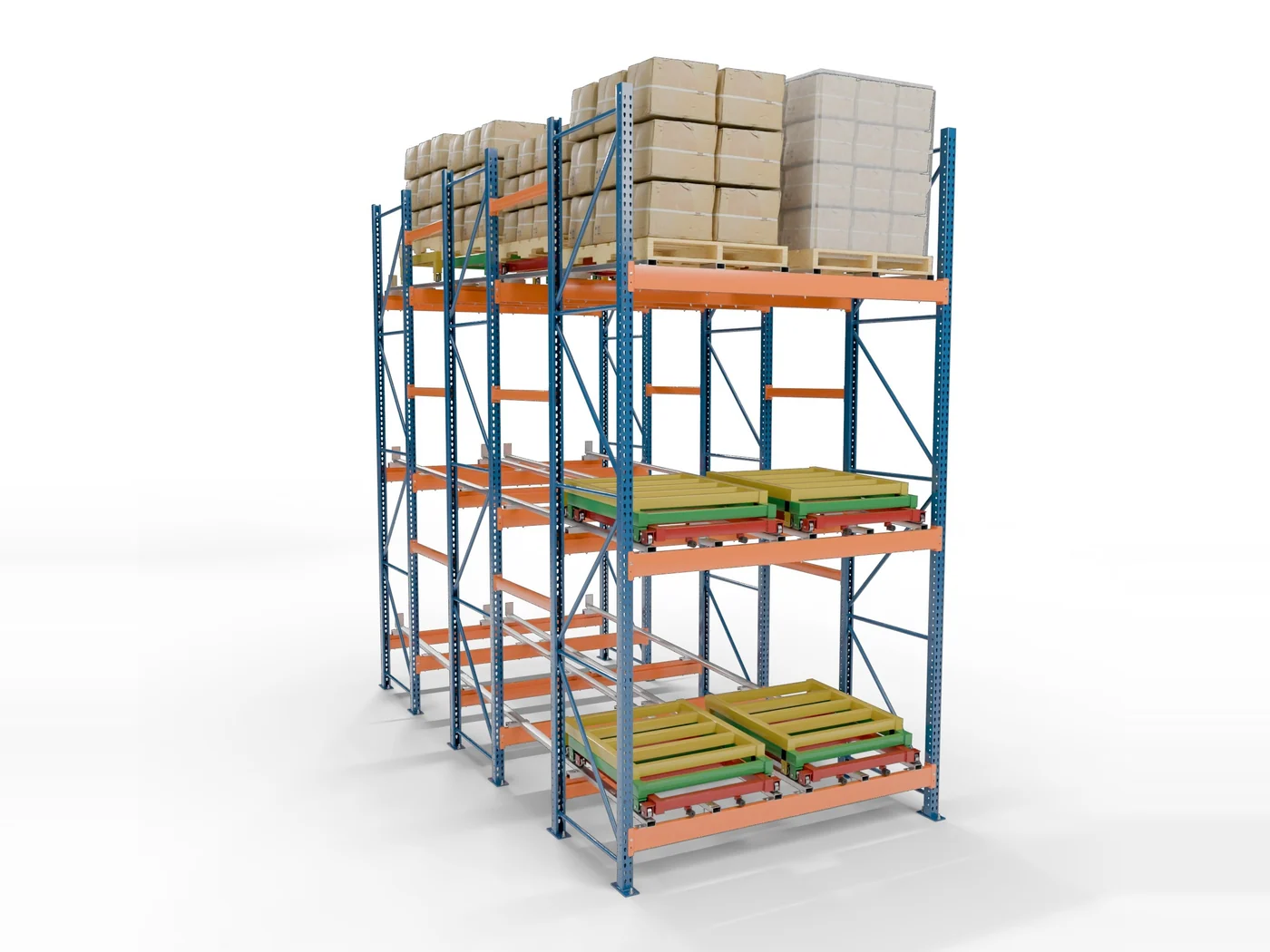
Sizes and Capacities
| Item | Typical |
|---|---|
| Lane depth | 16' 6" to 17' |
| Rail slope | 3/8" per foot (about 6" to 7" of rise) |
| Pallets per lane per level | 4 |
| Cart capacity | 2,500 to 3,500 lb each; 4,000 lb heavy duty |
| Levels | 3 to 4 (the carts add height per level; the maker's drawing gives it) |
| Truck | Counterbalance or reach truck with the lift, capacity and push the maker specifies |
Where 4-Deep Fits
- Four to eight pallets per SKU: beverage, paper, packaging, frozen food.
- Replacing 4-deep drive-in.
- One SKU per lane.
Many SKUs, few pallets each: 3-deep or 2-deep stores more.
What the Floor Needs
The maker sets the floor tolerance; beyond it, shims. We shoot the floor before quoting.
Common questions
How many pallets does a 4-deep push-back hold?
Four per lane per level. One lane 4 levels high holds 16; a two-lane bay holds 32, so ten bays hold 320.
Is 4-deep push-back better than drive-in?
Often, when SKUs fill whole lanes: a SKU per lane and level, and no truck in the rack. Drive-in can cost less per position.
Can push-back go deeper than 4?
Five and six deep exist, with lanes of 20 feet and more. Past 4 deep, drive-in or pallet flow is usually better.
Does 4-deep need a special forklift?
Not a deep-reach truck. It must reach the top level and have the capacity and push the maker specifies.


