
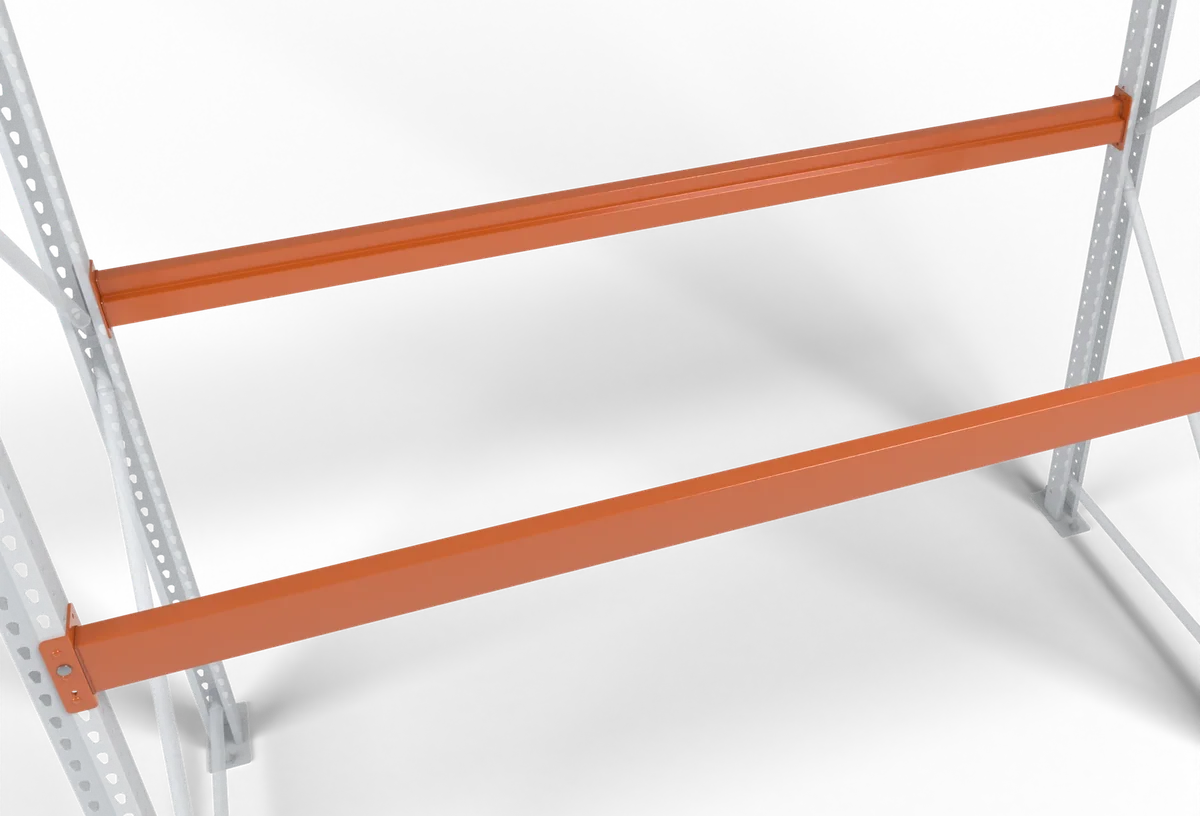
Three Ratings, One Rack
A rack has three kinds of rating: the beam pair (per level), the upright frame (carrying half of every level in the bays each side), and the decking (per deck or support). Each is checked against the load that actually reaches it; the smallest printed number is not the rack's capacity. Most assume an evenly spread load, and the plaque states them.
Beam Capacity
- Rated per pair, uniformly distributed. Two 2,000 lb pallets need a 4,000 lb pair plus margin.
- Set by the beam's section (face height, width, gauge), steel, connector and length. Face height alone does not give the capacity; the maker's chart does.
- Point loads (drum on its chime, crate on runners, coil) do not convert to an even load by a fixed factor. Contact area, position and span decide; tell us, so the rating covers the real load.
- Deflection limit is length ÷ 180 at rated load.
- Capacities come from the maker's chart; used beams are matched to it or rated by the engineer.
Frame Capacity
- The frame carries all levels above the floor in the bays each side: 4 elevated levels of 4,000 lb pairs put 4 x 4,000 = 16,000 lb on an interior frame with both bays equally loaded. An end frame carries about half that.
- It depends on beam spacing: the beams brace the column, so wider spacing means a lower rating. The frame chart gives the rating at each spacing.
- Column gauge and section, bracing, anchoring and seismic loads all count.
- A tall first level for floor stacking cuts the rating.
Decking
- A 42" x 46" three-channel wire deck is often rated 2,500 to 2,700 lb spread evenly, but channel count alone does not set it; the deck maker's rating does. A uniform rating does not cover pallet runners or other point loads, and how much of a pallet's weight reaches the deck depends on how it sits.
- Pallet supports are rated per bar by the maker. How many a pallet needs depends on the pallet, its runners and the load; drums and short pallets need an approved arrangement.
- Solid decks are rated for distributed load; concentrated loads need a heavier deck.
Seismic and Site
In seismic design categories D to F (including parts of the Northeast), frames rate lower, anchors are bigger and some layouts need extra bracing or base plates. See permits and engineering.
Load Plaques
Each row's plaque adds maximum load per bay and deck rating. Move beams and we re-rate and re-plaque.
Reading a Capacity Chart
Beam charts list length and section with capacity per pair; frame charts list column section and gauge against beam spacing. Some makers publish per beam, not per pair. Ratings assume beams are clipped and fully seated.
Quick Rules
- Design for the heaviest pallet, not the average.
- Keep beam spacing even; one big gap lowers the whole frame's rating.
- Pick the beam from the maker's chart for the heaviest pallet, not from face height.
- Decks do not raise beam capacity.
The beam capacity calculator does the math; we confirm your frame rating.
Common questions
Is pallet rack beam capacity per beam or per pair?
Per pair, almost always, with the load spread evenly. A 4,500 pound rating means two beams together carry 4,500 pounds. A few makers quote per beam, so check.
Why does the upright frame capacity depend on beam spacing?
The beams brace the column; the longer the unbraced length, the less it carries before buckling. Moving beams changes the rating.
How much weight can a pallet rack hold?
It depends on the beam and frame sections, the beam spacing and the maker. The maker's charts give the numbers, and the load plaque states them for your installed rack.
What is a load plaque?
The sign on each row stating beam, bay and frame capacities at the installed spacing. Insurers and fire marshals check it first.


